The Power of a Place: What It Can Teach Us About Dignity
By Becky Santoro
For a child experiencing foster care, where you spend time with your family can change everything.
It matters whether you are sitting across a conference room table under fluorescent lights or curled up on a couch. Whether a parent has to spend their visit in one supervised room or has space to move from room to room. Whether siblings separated by foster care get to play together somewhere that feels familiar and safe.
For many families, visits have traditionally happened in DSS offices, public parks, fast-food restaurants, or other community spaces.
We wanted to create something different. And because a village of people believed it was possible, we did.
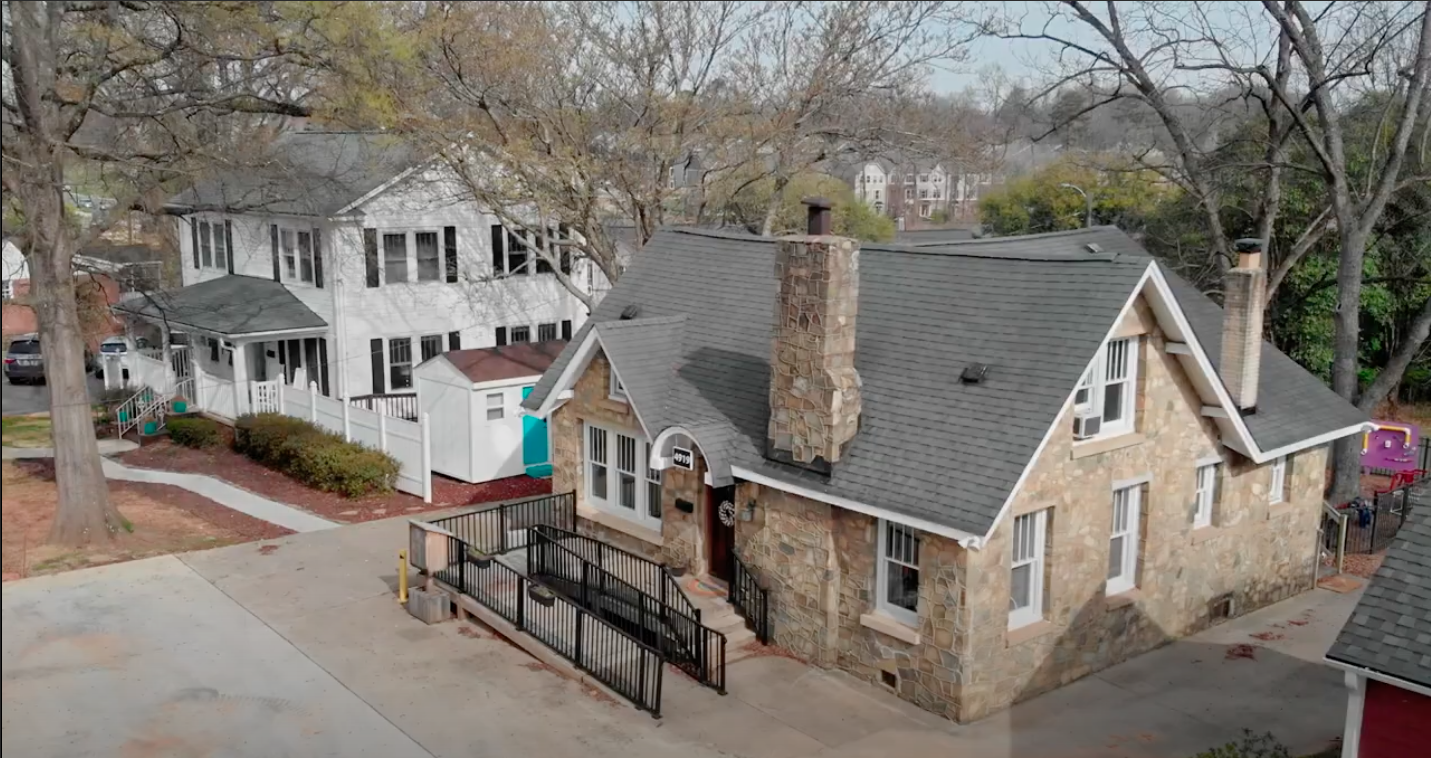
In January 2023, Foster Village Charlotte opened the Connection Cottage, a trauma-informed visitation home designed around a simple question:
What if family visits actually felt like family time?
For Me, It's Personal
During my time as a foster parent, some of my only opportunities to connect with a child's parent happened in the parking lot and elevator at the DSS office before their visit. I remember how much the system's imbalance shaped those weekly interactions, going through security, waiting in the lobby, and feeling the tension, knowing that for two hours, they would be in one tiny room.
Years later, my daughter's earliest memories of her parent are mostly tied to that DSS room.
My pursuit of the Connection Cottage came from a desire to build better experiences for relationships and memories, and to shift that imbalance by creating a place where a child's parents know that we are rooting for their family, too.
In many ways, the Connection Cottage is a love letter to my child and her first family, a tangible expression of what I wish they had experienced, and what is now possible for families who came after them.
What Dignity Makes Possible
The Connection Cottage at Foster Village Charlotte isn't special because it has a kitchen, a comfy couch, or a sensory play room, although those things are pretty amazing too. It's special because those things make something else possible.
A parent can make a meal for their child. A child can pull a book off the shelf and curl up next to their mom. Siblings can jump into a foam pit. A grandparent can celebrate a birthday. A foster parent and biological parent can sit at the same table and talk about what their child needs. These ordinary moments are extraordinary in the context of foster care.
Dignity can sometimes feel like an abstract idea within the foster care system. At the Connection Cottage, we get to see what it looks like: having a place where your family can celebrate a birthday, having a reliable place to visit when you don't have consistent transportation, and being given the space and time to simply be a family.
And sometimes, one ordinary moment tells the whole story.
One visit supervisor recently shared this:
"The dad usually pays for a place like a bowling alley so they aren't meeting at DSS. At one point they were on the floor playing at the Connection Cottage, and the oldest son crawled in his dad's lap while his dad rubbed his head. A bonding moment that couldn't have happened at a bowling alley."
I keep coming back to that image. An older child crawling into his dad's lap. His dad rubbing his head. It may seem like a simple moment. But in foster care, it can be extraordinary. For that moment, they simply got to be a family.
When people feel safe, respected, and seen, relationships have more room to grow and heal. Visitation isn't simply about checking a box that a visit occurred. It is about creating the conditions for relationships to grow. Consistent, meaningful connection between children and their parents is a critical part of the reunification process.
That is what dignity makes possible.
We Know It Matters Because Families Tell Us
Families have told us that the Cottage has become a place they can count on. A safe, consistent space where their children can maintain relationships with the people they love.
One foster parent shared in our recent annual survey:
"The Connection Cottage has been so helpful for the relationship with our kiddo's biological family. From birthday parties to visits with grandparents and siblings. It has allowed us a safe, consistent place that my children look forward to going to."
The Cottage also gives social workers and visit supervisors something they have told us they need: a reliable, trauma-informed environment where they can support family connection without the limitations of government offices or the unpredictability of public spaces.
Since opening, the Connection Cottage has hosted 725 family experiences; from visits and sibling connections to birthdays, meals, and the ordinary moments that might not have happened in a traditional visitation setting.
The Connection Cottage has taught us that sometimes changing a system starts with changing something very tangible. It doesn't remove the hard things about foster care, but it changes a critical condition in which those hard things happen.
And that matters.
Trust between a parent and child doesn't rebuild itself just because a visit is scheduled. It rebuilds through intentional connection - through play, through shared meals, through the small, repeated moments of simply being together. Research on foster care reunification has consistently found that children who receive regular, consistent visits with their parents are significantly more likely to be reunified with their families. Visits aren't just a box to check on the way to reunification - they're often the thing reunification is built on.
If we want children to have the chance to build and maintain healthy relationships with the people they love, we have to create places where those relationships can grow. A place to play, to connect, to celebrate, to have hard conversations, and to simply be together. That's what dignity looks like in practice. It's not an abstract idea. Sometimes, it's a room with a couch and a kitchen table where a family gets to be a family.
This Should Be the Norm
The Connection Cottage has shown our community what is possible.
What if home-like, trauma-informed visitation wasn't the exception, but the expectation? What if every child experiencing foster care had a place to spend time with their family that felt safe, warm, and familiar? And what if the child welfare system began asking not only, "Did the visit happen?" but also, "What did that visit make possible?"
Most visits occur in the afternoons and early evenings. As we look ahead to our next strategic plan for 2027–2029, we hope to replicate the Connection Cottage so more families can experience what happens when family time takes place somewhere designed with dignity in mind. A second Connection Cottage would allow us to double high-demand visit availability and expand access for families who need it most.
When I think about the Connection Cottage, I still think about that DSS room. I think about the moments that happened there, and the moments that never could.
I can't change what my daughter and her first family experienced. But because of everyone who has stood behind this vision, I can help build something different for the families who come through our doors today.
Sometimes dignity starts with something as simple as a couch, a kitchen table, a place to play, and the message that every child deserves family time that feels like home.
If you'd like to help us bring a second Connection Cottage to life for families in 2027–2029, send me an email at becky@fostervillagecharlotte.org. I'd love to connect.